6 Future-Ready Skills Every Fresher Should Learn in 2026
 Poonam Bhardwaj | Sep 14, 2026 | 8 minutes read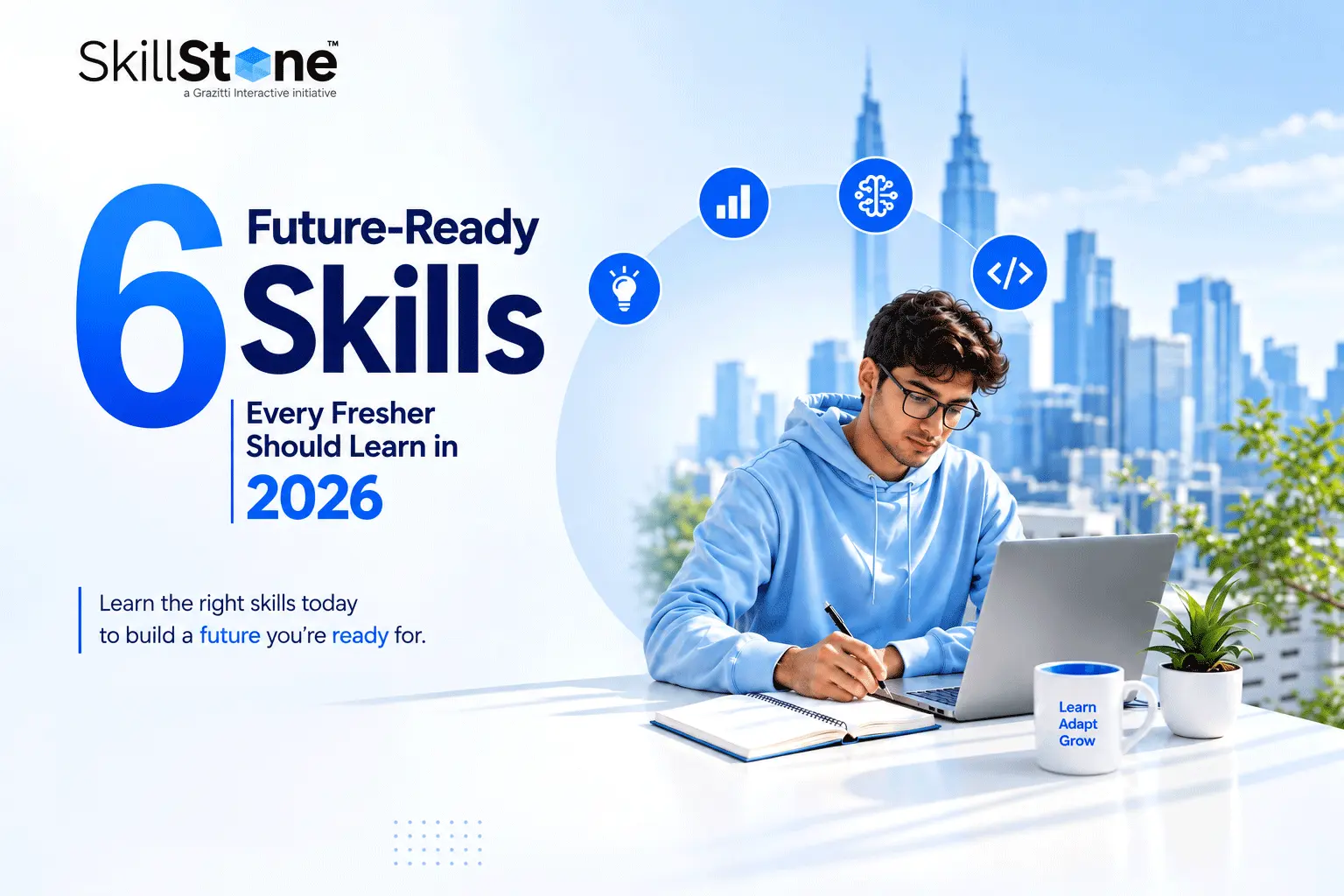
Your first job in 2026 may look different from what you imagined when you started college. AI is already helping people write, code, analyse, research, and create. For freshers, the opportunity is to learn how to use these tools while strengthening the skills that help them make decisions, understand their field, communicate clearly, and solve problems. Six skills stand out: AI fluency, critical thinking, communication, domain knowledge, learning agility, and creative problem-solving. The goal is not to become “AI-proof” in the literal sense. It is to become someone who can work with technology, think independently, keep learning, and create useful outcomes.
Think back to your first day of college. You probably had a fairly simple plan: attend classes, complete your projects, find an internship, graduate, and eventually land your first job.
A lot can change in four years.
Today, AI can explain a difficult concept, help debug code, analyse data, generate ideas, and even help you practise for an interview. You may already be using it for your coursework or personal projects.
That is not necessarily something to worry about. It is an opportunity to start your career with tools that can help you learn and work faster.
The more useful question is: What skills will help me use those tools well?
The World Economic Forum's Future of Jobs Report 2025 puts analytical thinking at the top of its list of core skills, while AI, big data, and technological literacy are among the fastest-growing skills
Here are six worth building.
1. AI Fluency
You do not need to become an AI engineer to be good at AI.
For a fresher, AI fluency means knowing where AI can help and how to use it responsibly. A marketing student might use it for research and campaign ideas. A developer might use it to understand code or find bugs. A finance student could use it to organise information or explore data.
The important part is not how many AI tools you know. It is whether you can use the right tool for the right task.
Build this skill by learning to:
- Give AI useful context
- Ask clear questions
- Check its output
- Refine weak responses
- Protect sensitive information
- Know when human input is needed
Simple rule: Use AI to speed up your work, not to switch off your thinking.
2. Critical Thinking and Judgment
AI can give you an answer in seconds. Your job is to decide whether it deserves to be trusted.
Suppose an AI coding tool gives you a solution that fixes an error. Before using it, you still need to understand why it works, check whether it is secure, and make sure it actually solves the problem.
The same applies to marketing ideas, business recommendations, research summaries, or data analysis.
Microsoft's 2026 Work Trend Index found that AI users rank quality control of AI output (50%) and critical thinking (46%) among the human skills becoming more important as AI takes on more work.
The takeaway: Let AI give you options. You make the decision.
3. Communication and Collaboration
Knowing the answer is useful. Being able to explain it is even better.
As a fresher, you may have to present a project, explain a technical issue to a non-technical teammate, ask a client the right question, or write a clear email.
Good communication does not mean using complicated words. It means making your ideas easy to understand.
It also means listening. Before solving a problem, understand what the other person actually needs.
AI can help you draft the message. You still need to understand the conversation.
Practise these habits:
- Explain complex ideas in simple language
- Ask when something is unclear
- Listen before proposing a solution
- Give and accept feedback
- Adjust your communication for different audiences
4. Domain Knowledge
Knowing how to use AI is useful. Knowing where to apply it is even more valuable.
Imagine two students using the same AI tool for a marketing task. One knows how to prompt the tool. The other understands prompting and also knows customers, analytics, positioning, and campaign strategy.
The second student has more context, so they can ask better questions and spot weak suggestions faster.
That is why your chosen field still matters.
| Career area | Build knowledge in |
|---|---|
| Software | Programming, systems, security |
| Marketing | Customers, content, analytics |
| Data | Statistics, data quality, business context |
| Finance | Financial concepts, risk, reporting |
| Design | Users, usability, visual principles |
Think of it as AI + expertise. The tool gives you speed; domain knowledge gives you direction.
5. Learning Agility
The tool you learn today may not be the tool you use two years from now.
That is normal.
Your advantage as a fresher is your ability to learn. Build on it by trying unfamiliar tools, taking on new projects, asking questions, and learning from mistakes.
The World Economic Forum identifies resilience, flexibility and agility, creative thinking, curiosity, and lifelong learning among important skills for the future workforce.
You do not need another ten certificates just to prove you are learning.
Try this instead:
Learn → Apply → Get feedback → Improve
That habit will stay useful long after a particular course becomes outdated.
6. Creative Problem-Solving
AI can generate ten ideas before you finish your coffee.
That makes your ability to choose, improve, and apply ideas more important.
Suppose you want to build an app for college students. AI can suggest features, but you still need to find out what students actually need, identify the real problem, test your assumptions, and decide what is worth building.
Creative problem-solving is not limited to creative careers. Developers, marketers, analysts, entrepreneurs, and business professionals all use it.
The WEF ranks creative thinking among the leading core skills employers value.
Turn These Skills Into Proof of Work
Knowing these skills is one thing. Showing them is better.
Instead of simply writing “good problem-solving skills” or “AI-proficient” on your resume, build something that demonstrates them.
For example:
| Your interest | Possible proof of work |
|---|---|
| Software | Website, app, automation |
| Data | Dashboard, data analysis |
| Marketing | Campaign or case study |
| Design | Portfolio or UX project |
| Business | Market research or business case |
You do not need ten projects. Start with two or three that you genuinely understand.
Be ready to explain:
- What problem did you solve?
- How did you approach it?
- Where did AI help?
- What did you change?
- What did you learn?
That gives recruiters something much more useful than a list of buzzwords.
How Can Freshers Start?
You do not need to master all six skills at once.
Pick a direction: Choose an area you want to explore seriously.
Learn the basics: Build strong fundamentals before relying heavily on AI.
Use AI while learning: Ask it to explain concepts, challenge your ideas, or review your work. Verify the answers.
Build something: Turn what you learn into a small project.
Get feedback: Show it to a mentor, professor, senior, or friend and ask what they would improve.
Keep building: Save your projects and learn from each one. Over time, they become your portfolio.
The Real Meaning of “AI-Proof”
No career can honestly promise to be completely AI-proof.
The better goal is to build skills that remain useful because you know how to work with technology rather than simply depend on it.
AI fluency helps you use the tools. Critical thinking helps you evaluate them. Communication helps you work with people. Domain knowledge gives you context. Learning agility helps you keep up. Creative problem-solving helps you turn ideas into outcomes.
That combination is what makes a fresher more prepared for the workplace of 2026 and beyond.
Conclusion
Your first job does not need to be the perfect job. What matters more is whether you are entering it with the mindset to learn, contribute, and grow.
So, before you spend another month adding random courses to your resume, pause and ask yourself: What kind of professional do I want to become, and what can I start building today to move in that direction? Pick a field that interests you, develop skills that support it, work on something real, and use AI as a tool to accelerate your progress.
You do not have to have your career figured out before graduation. You just need to make your next decision count.
Build More Than a Resume. Build the Skills, Experience, and Confidence to Make an Impact From Day One.
Explore SkillstoneFAQs
What skills should freshers learn in 2026?
Freshers should focus on AI fluency, critical thinking, communication, domain knowledge, learning agility, and creative problem-solving. These skills complement technical knowledge and help candidates apply what they learn in practical situations.
Do non-technical students need AI skills?
Yes. AI is being used across marketing, finance, HR, sales, design, operations, research, and other functions. Non-technical students do not need to learn AI development, but they should understand how AI can support their chosen field.
Is knowing ChatGPT enough to become AI-ready?
No. Using an AI chatbot is only a starting point. AI readiness also means knowing how to frame problems, provide context, evaluate responses, verify information, and apply AI appropriately.
How can freshers build experience without a job?
Internships, college projects, hackathons, freelance work, open-source contributions, competitions, and self-directed projects can all provide practical experience. Choose activities that give you something concrete to demonstrate.
Should students use AI for college projects?
They can use AI where their institution's rules permit it. AI can help with research, brainstorming, explanations, and feedback, but students should understand and be able to explain the work they submit.