Internship vs Certification: What Gets You Hired Faster?
 Poonam Bhardwaj | Sep 28, 2026 | 11 minutes read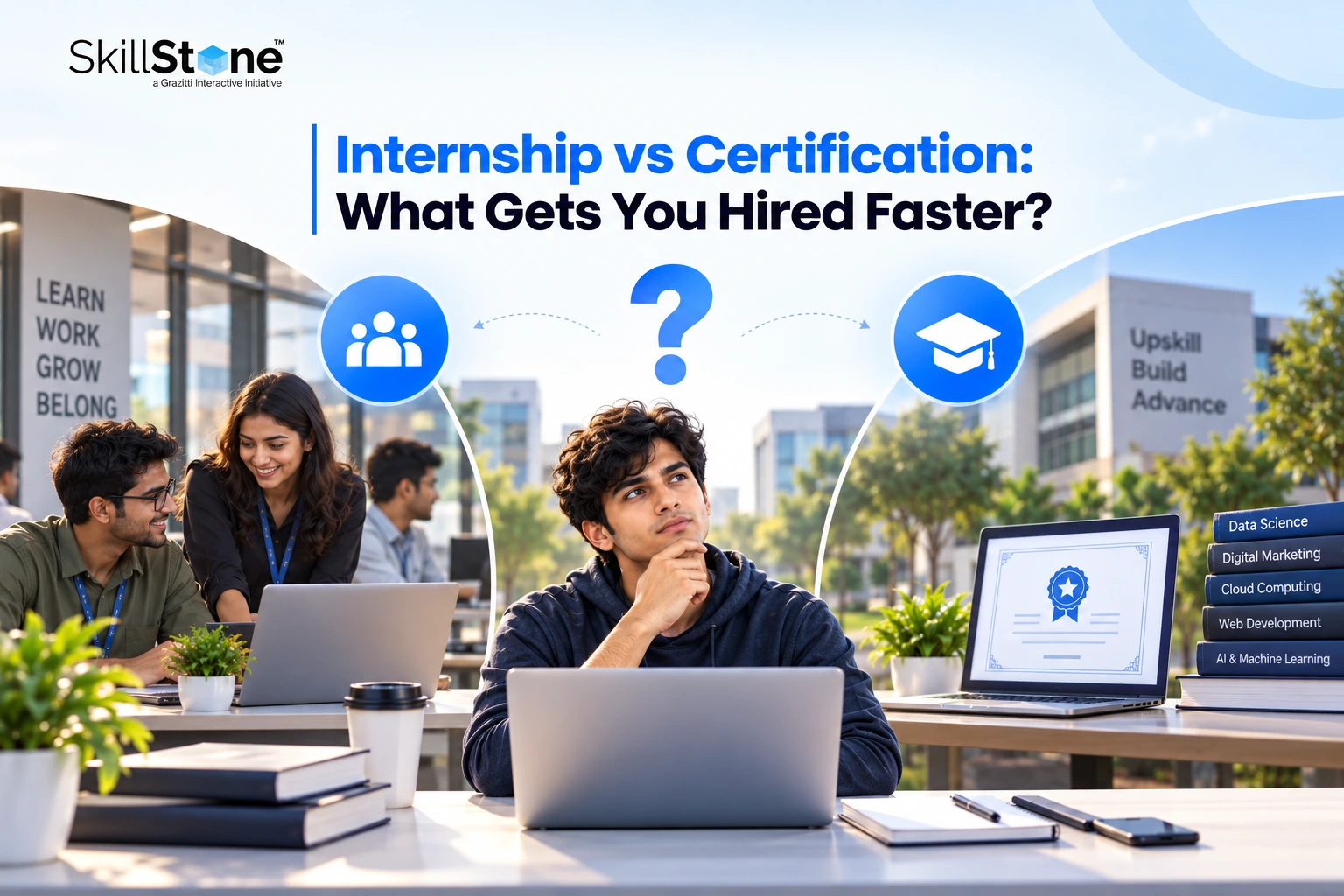
If you are a fresher trying to decide between an internship and a certification, start by looking at what your profile is missing.
A certification shows that you have learned a particular skill in a structured way. An internship shows that you have used your skills in a real work environment.
If you have little or no practical experience, an internship will usually add more value to your resume. If you already have practical experience and need to build or validate a specific skill, a relevant certification can be a smart choice.
The strongest profile is not built around certificates or internships alone. It combines skills, projects, practical experience, and relevant certifications.
Placement season is getting closer.
One friend is completing a certification. Another has already landed an internship. Someone else is building projects and adding them to GitHub. You have limited time and perhaps enough budget for only one option.
So, what should you choose?
An internship or a certification?
It is an important question because both can strengthen a fresher's resume, but they show different things to recruiters.
The hiring market also makes the decision more important. Mercer India’s Graduate Skill Index 2025 found that only 42.6% of Indian graduates who apply for jobs are overall employable. (i) The report also highlights skills such as communication, critical thinking, and learning agility as important alongside technical knowledge.
In other words, knowing something is not always enough. Employers also want to know whether you can use what you know.
That is where the difference between an internship and certification becomes important.
What Is an Internship?
An internship lets you work on tasks, projects, or responsibilities in a professional environment before you start your full-time career.
For a fresher, that experience can be valuable because it takes learning beyond the classroom.
During an internship, you may have to:
- Work with a team
- Follow deadlines
- Attend meetings
- Communicate with managers or clients
- Use industry tools
- Solve problems you have not seen before
- Take feedback and make changes
- Complete work that serves a real purpose
These experiences help you understand what working in your chosen field actually looks like.
They also give you something useful to talk about during an interview.
Instead of saying, “I know Python,” you may be able to say, “I used Python to clean and analyse a dataset during my internship.”
That difference matters.
What Is a Certification?
A certification is a formal way of demonstrating that you have completed a specific learning or assessment process.
It can help show that you have developed knowledge in an area such as cloud computing, data analytics, cybersecurity, digital marketing, project management, or a particular technology.
For freshers, certifications can be useful when they are:
- Relevant to the job you want
- From a credible provider
- Aligned with current industry requirements
- Supported by practical work
- Used to fill a specific skill gap
But there is one thing to remember.
A certification can show that you learned something. It does not automatically show that you can use it at work.
For example, completing a certification in data analytics is useful. But being able to analyse a dataset, create a dashboard, identify an issue, and explain your findings gives a recruiter much more evidence of your ability.
That is why collecting certifications without developing practical skills can have limited value.
Internship vs Certification: Which Is Better for Freshers?
There is no universal winner.
The better option depends on what your profile needs right now.
| Factor | Internship | Certification |
|---|---|---|
| Practical experience | High | Limited |
| Industry exposure | High | Usually low |
| Structured learning | Depends on the internship | High |
| Skill validation | Through actual work | Through learning or assessment |
| Workplace skills | Strong evidence | Limited evidence |
| Interview discussion | More opportunities | Fewer opportunities |
| Networking | Stronger | Depends on the provider |
| Time commitment | Usually higher | Usually more flexible |
| Best use | Building experience | Learning or validating a skill |
If you have never worked on a professional project, an internship can help close that gap.
If you already have projects or experience but need to strengthen a particular skill, a certification may make more sense.
So instead of asking, “Which one is better?”, ask:
“What is missing from my profile?”
That question will usually lead you to the right answer.
When Should You Do an Internship?
An internship should be a priority when you need practical experience.
Consider one if:
- You have no professional experience.
- Your resume mostly contains academic achievements.
- You are preparing for campus placements.
- You want to understand how your chosen industry works.
- You need real projects for your portfolio.
- You want to improve communication and teamwork.
- You are unsure whether a particular career is right for you.
When Should You Get a Certification?
A certification makes more sense when you have a clear skill or career goal.
You may want to pursue one if:
- You want to learn a new technology.
- You have identified a specific skill gap.
- Your target role values a particular certification.
- You already have practical experience.
- You want to move into a specialised area.
- You do not currently have enough time for an internship.
- You want to build a foundation before applying for internships.
The key is to choose carefully.
Do Projects Matter for Freshers?
Yes. In many cases, projects can connect the learning you get from a certification with the practical experience you gain through an internship.
Think of it this way:
Certification: I learned this.
Project: I built something using this.
Internship: I used this in a professional environment.
A student who completes a certification and then builds a project around it has stronger evidence than a student who only lists the certification.
For example, if you complete a certification in web development, you could build a responsive website and publish the code on GitHub.
If you study data analytics, you could work with a public dataset and create a dashboard.
If you learn cloud computing, you could build and document a small cloud-based application.
Projects give you something concrete to show and discuss.
They also help answer one of the most common questions in interviews:
“What have you actually done with this skill?”
What Do Recruiters Look For in Freshers?
Recruiters do not evaluate a candidate based on one certificate or one internship alone.
They look at the overall profile.
Some of the things that can influence the hiring decision include:
- Technical knowledge
- Problem-solving ability
- Communication
- Teamwork
- Projects
- Internship experience
- Understanding of the role
- Adaptability
- Ability to learn
- Portfolio or GitHub, where relevant
- Ability to clearly explain previous work
NACE's 2026 internship research also highlights skills such as communication, critical thinking, professionalism, adaptability, time management, and initiative that employers consider when differentiating between candidates.
What Should Freshers Do First?
If you are starting from scratch, a practical approach is:
Learn → Build → Get Certified → Gain Experience → Apply
But do not treat this as a fixed formula.
You could complete a certification before building a project. You could get an internship while continuing to learn. You could even find an internship first and then pursue a certification based on the skills you discover you need.
The important thing is that your choices should connect.
For example:
Learn: Pick a career area and build the basics.
Build: Create one or two projects using those skills.
Get Certified: Choose a relevant certification that strengthens your knowledge.
Gain Experience: Apply for internships and use your skills in a real environment.
Apply: Build your resume around what you can actually demonstrate.
This approach is much stronger than collecting certificates simply to make your resume longer.
Internship and Certification Roadmap for College Students
You do not need to do everything in your first year. Your priorities can change as you get closer to graduation.
| Career Stage | What to Focus On |
|---|---|
| 1st–2nd Year | Explore career options, learn fundamentals, and try small projects |
| 2nd–3rd Year | Build job-ready skills and start creating stronger projects |
| 3rd Year | Apply for internships and pursue relevant certifications |
| Final Year | Strengthen projects and internship experience, prepare for placements |
| After Graduation | Apply for jobs, improve weak areas, and use targeted certifications where needed |
Common Mistakes Freshers Should Avoid
Collecting Too Many Certifications
A long list of certificates does not automatically mean you have strong skills.
Choosing Certifications Randomly
There should be a clear reason for pursuing a certification. It should support the career path you are targeting.
Taking an Internship Only for the Certificate
If you cannot explain what you worked on, what you learned, or what you contributed, the internship will have limited value.
Choosing an Unrelated Internship
Not all experience is necessarily valuable. Whenever possible, choose internships that connect with the roles you want to pursue.
Ignoring Projects
Projects give you a way to demonstrate your skills, especially when you do not have much professional experience.
Not Documenting Your Work
Keep track of the tools you used, problems you solved, tasks you handled, and results you achieved during your internship.
Adding Skills You Cannot Explain
If a skill appears on your resume, be prepared to answer questions about it.
How to Decide Between an Internship and Certification
Still unsure?
Use your current situation to decide.
| Your Situation | What to Prioritise |
|---|---|
| You have no practical experience | Internship |
| You have a clear skill gap | Certification |
| You want to explore a career | Internship |
| You already have practical experience | Certification |
| You need projects for your portfolio | Internship + projects |
| You have limited time | Targeted certification + project |
| You can manage both | Combine them |
Conclusion
So, internship vs certification: what gets you hired faster?
For most freshers with little or no practical experience, an internship can provide a stronger hiring signal because it shows how you apply your skills in a real work environment.
But that does not make certifications less useful.
A relevant certification can help you learn a new skill, fill a gap, or demonstrate focused interest in a career path. Add projects to the mix, and you have something tangible to show for that learning.
The real goal is not to collect more certificates or simply add an internship to your resume.
It is to build a profile that answers a recruiter's basic question:
“Can this candidate do the work?”
The more clearly you can answer that question through your skills, projects, internship experience, and relevant certifications, the stronger your chances become.
Not Sure What Your Profile Needs Next? Get Guidance to Choose the Right Skills,
Certifications, and Practical Experience for Your Career Goals.
Have questions about choosing the right path for your career? Reach out to us at [email protected].
FAQs
Can I get a job without an internship or certification?
Yes. Internships and certifications can strengthen your profile, but they are not the only ways to demonstrate your ability. Strong projects, freelance work, open-source contributions, competitions, academic projects, and good interview performance can also help you stand out.
Are online certifications useful for freshers?
Yes, if they are relevant to your target role and come from a credible provider. The best certifications for freshers are those that help develop a skill employers actually need and can be supported with projects or practical work.
How many certifications should a fresher have?
There is no fixed number. A few relevant certifications are usually more useful than a long list of unrelated ones. Focus on whether each certification adds value to the role you want.
Do internships count as work experience for freshers?
Internships are generally listed separately from full-time employment, but internship experience can still demonstrate professional exposure. Mention the work you performed, tools you used, projects you contributed to, and results you achieved.
Is a paid internship better than an unpaid internship?
Not necessarily. Compensation is important, but students should also consider the quality of the work, mentorship, learning opportunities, project exposure, duration, and relevance to their career goals.
What are the best certifications for freshers in IT?
There is no single list that works for every student. The right certification for jobs depends on the role you want. A cloud certification may be useful for an aspiring cloud professional, while a data analytics, cybersecurity, software development, or project management certification may make more sense for a different career path.
How long should a fresher's internship be?
There is no universal ideal duration. A meaningful internship should give you enough time to understand the work, contribute to projects, receive feedback, and build something you can discuss in interviews. The quality of the experience matters more than simply reaching a particular number of months.
How can I get hired as a fresher with no experience?
Start by creating evidence of your skills. Build relevant projects, develop strong fundamentals, apply for internships, consider targeted certifications, improve your resume, and practise explaining your work in interviews. Your first goal should be to show what you can do, even if you have not yet held a full-time job.

You may also like
How to Start Preparing for Campus Placements Early