How to Start Preparing for Campus Placements Early
 Poonam Bhardwaj | Sep 16, 2026 | 10 minutes read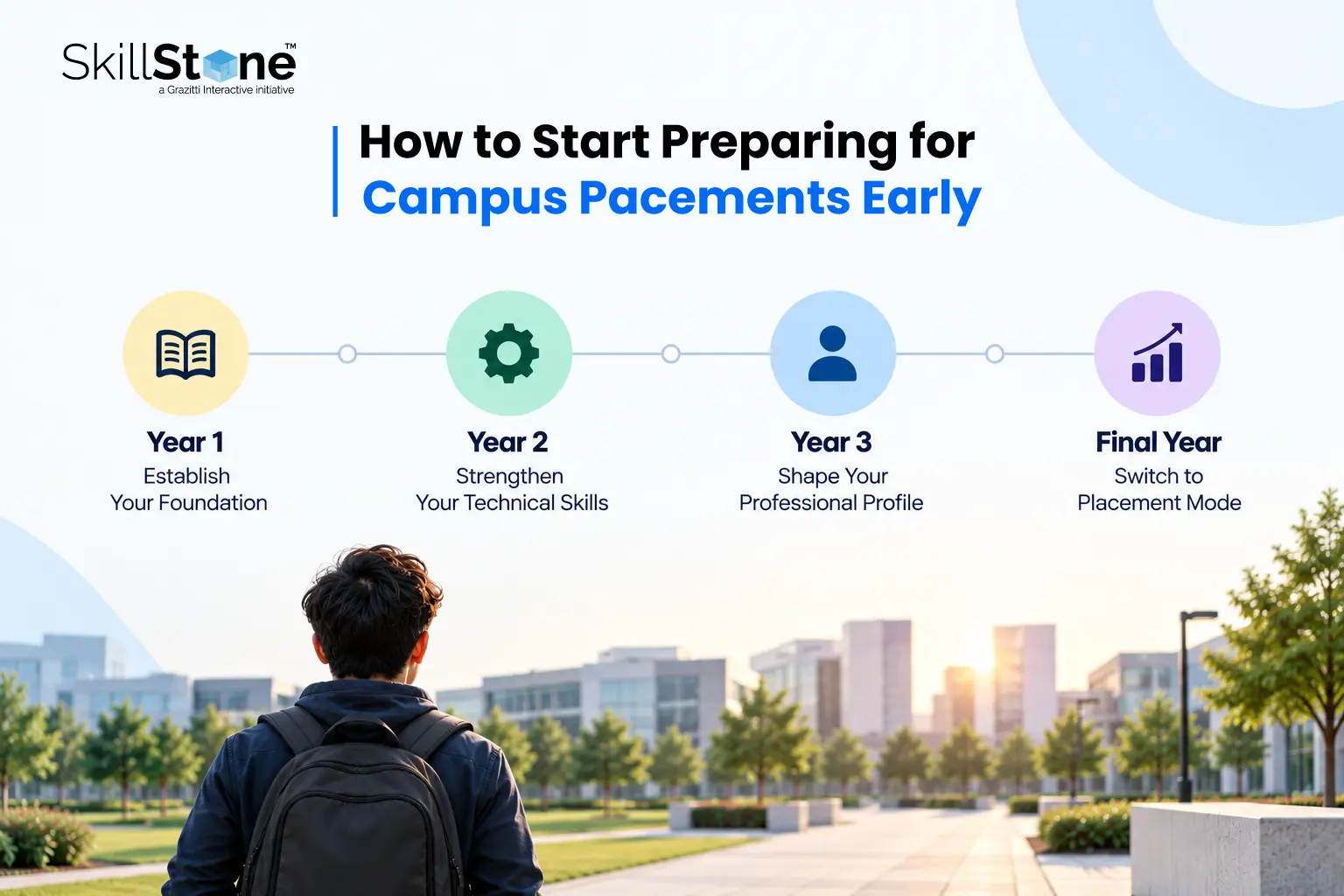
For many college students, campus placement preparation starts when placement season is already upon them.
Trying to learn to code, solve aptitude questions, build a resume, and prepare for interviews all at once can leave you feeling overwhelmed and underprepared.
A better approach is to start preparing early and use each year of college to build a different part of your career readiness. Instead of trying to develop every skill just before placements, you can gradually strengthen your technical knowledge, problem-solving abilities, and communication skills while gaining practical experience and interview readiness throughout college.
Effective placement preparation for college students is about more than having a degree or knowing how to code. It also means developing the skills that help you navigate the workplace and demonstrate what you can bring to a role.
In this post, we'll break down a year-by-year campus placement preparation roadmap, showing what you should focus on at each stage, when to start working on coding and aptitude, and how to prepare for placements.
How Your Campus Placement Preparation Should Evolve Each Year
Campus placement preparation doesn't have to look the same throughout college. Think of it as a progression: build the foundation, strengthen your skills, develop your profile, and then prepare to perform.
Here's what your placement preparation strategy can look like at each stage of college.
Year 1: Establish Your FoundationDon’t make your first year all about rushing into technical interview preparation or trying to solve advanced coding problems. Use that time to build a foundation that will make your preparation easier in the years ahead.
During semester 1, start by getting comfortable with programming fundamentals and basic computer science concepts. If you're new to programming, choose one language and focus on understanding the basics rather than jumping between multiple languages.
In the next semester, you can start with some technical learning, work on communication skills, explore different career paths, and get familiar with tools such as Git and GitHub.
By the end of your first year, you should have a foundation in at least one programming language, basic problem-solving skills, some practical work to showcase, and a clearer idea of the career or technology areas you want to explore.
Year 2: Strengthen Your Technical SkillsYour second year is the time to move from learning basic programming concepts to developing the technical skills that will matter in internships and technical placement rounds.
Make Data Structures and Algorithms (DSA) a regular part of your learning routine. At the same time, strengthen your understanding of core computer science subjects such as Object-Oriented Programming, DBMS, Operating Systems, and Computer Networks. You can also start developing your SQL and software development skills.
Focus on understanding how they work and practicing how to apply them. With a better understanding of core CS concepts, regular coding practice, and a few projects that demonstrate what you've learned, you will have the confidence needed to complete coding assessments and clear technical interviews.
Year 3: Shape Your Professional ProfileYour third year is when your placement preparation for freshers should start moving beyond learning and toward building a profile that demonstrates what you can do.
Continue strengthening your Data Structures and Algorithms (DSA) and technical skills, but give equal attention to practical experience. Work on meaningful projects, look for internships, participate in hackathons, and start building a resume that reflects your skills and achievements.
This is also a good time to choose a career direction. Depending on your goals, this could be Full Stack Development, QA and Automation, Data Science, AI/ML, Cloud, Cybersecurity, or Digital Marketing.
Developing technological literacy alongside analytical and creative thinking can help you build deeper technical expertise and a professional profile you can confidently present to recruiters.
Final Year: Switch to Placement ModeThe skills, projects, and experience you've built over the previous three years now become the foundation for focused placement preparation.
Shift your attention toward aptitude tests, coding assessments, technical interviews, HR interviews, mock interviews, and company-specific preparation.
Review the skills required for your target roles, understand the hiring process of the companies you're applying to, and practice under conditions similar to the assessments.
Revise DSA and core CS concepts, practice aptitude and coding assessments, participate in mock interviews, and research your target companies and roles.
How to Prepare for Key Placement Skills
Knowing what to focus on during each semester is a good starting point. The next step is to turn that learning into a solid placement preparation strategy that you can apply. Here’s how.
Coding and DSA SkillsCoding preparation is about understanding programming concepts, developing a structured approach to problem-solving, and becoming comfortable writing, testing, and debugging code.
Your coding and DSA preparation can progress through:
- Programming fundamentals: Get comfortable with one programming language and understand its core concepts.
- Problem-solving: Start with basic problems and learn how to break a larger problem into smaller, manageable steps.
- Data Structures and Algorithms: Progress through topics such as arrays, strings, linked lists, stacks, queues, trees, graphs, sorting, searching, recursion, and dynamic programming.
- Regular practice: Solve problems consistently instead of trying to complete a large number of questions just before placement season.
- Timed practice: As you get closer to placements, introduce timed coding assessments to improve speed and accuracy.
- Interview-level problems: Practice explaining your approach, evaluating different solutions, and discussing the trade-offs behind your choices.
Projects allow you to demonstrate that you can apply what you've learned beyond coursework. A strong project doesn't have to be highly complex. It should show that you understand the problem, can make appropriate technical decisions, and can explain your contribution.
When working on projects, focus on:
Solving a real problem: Choose a problem you understand rather than simply recreating a tutorial.
- Applying your skills: Use technologies that are relevant to the problem and your chosen career path.
- Documenting your work: Maintain your code on GitHub and clearly explain the project, the technologies used, and your contribution.
- Taking ownership: Be prepared to explain which parts you developed, the decisions you made, and the challenges you faced.
- Gaining practical experience: Look for internships, hackathons, college projects, freelance opportunities, or other ways to apply your skills.
- Preparing to discuss your work: Practice explaining your project using a simple flow: Problem → Approach → Technology → Your Contribution → Challenge → Outcome.
Depending on the company and role, campus hiring can involve aptitude assessments, group discussions, presentations, technical interviews, and HR rounds. That makes aptitude and communication skills worth developing throughout college rather than adding them to your preparation only when placements begin.
You can gradually work on:
- Quantitative aptitude: Practice areas such as percentages, ratios, averages, probability, time and work, and data interpretation.
- Logical reasoning: Develop your ability to identify patterns, analyze information, and solve logical problems.
- Verbal ability: Work on reading comprehension, grammar, vocabulary, and sentence construction.
- Communication: Practice explaining your ideas clearly, both verbally and in writing.
- Presentation skills: Take opportunities to present projects, participate in classroom activities, or speak at college events.
- Group discussions: Practice expressing your point of view while listening to and building on others' ideas.
- Mock interviews: Engage in behavioral and technical interview preparation using mock rounds to gather actionable feedback.
Your resume should reflect the skills, projects, experiences, and achievements you accumulate throughout college.
As you progress through college, keep track of:
- Projects: Add relevant projects and highlight the technologies you used and the problems you solved.
- Internships: Include your responsibilities, contributions, and outcomes rather than simply listing the company and role.
- Certifications: Prioritize certifications that complement your skills and career direction.
- Hackathons and achievements: Include relevant competitions, awards, technical events, and other accomplishments.
- GitHub: Keep relevant repositories organized, documented, and up to date.
- LinkedIn profile: Maintain an up-to-date profile that reflects your skills, projects, experience, and career interests.
- Role-specific resumes: Adapt your resume to highlight the skills and experience most relevant to the position you're applying for.
- Trying to learn coding, aptitude, projects, and interview skills only in the final year can create unnecessary pressure. Start working on these areas gradually throughout college.
- Learning too many technologies at once can make it difficult to develop depth in any one area. Focus on the skills that align with your chosen career path.
- Relying on certifications without projects, internships, or hands-on practice can leave you with little to demonstrate. Make sure you can apply the skills you learn.
- Solving hundreds of coding problems without understanding the underlying concepts can limit your problem-solving ability. Focus on understanding patterns, approaches, and trade-offs.
- Ignoring aptitude and communication until placement season can make preparation stressful and rushed. Develop these skills gradually alongside your technical preparation.
- Using the same preparation strategy for every role and company can make your preparation less relevant. Research the requirements and hiring process for each opportunity and prioritize accordingly.
Are You Ready for Campus Placements?
Use this checklist to assess if you are ready to take on the placement process. If you find gaps, use them to identify what you should focus on next.
- Can you write programs confidently in at least one programming language and solve problems using the concepts you've learned?
- Do you understand the core computer science concepts (DBMS, OOP, Operating Systems, or Computer Networks) required for technical interview preparation?
- Do you have projects that demonstrate how you've applied your technical or domain knowledge, and can you confidently explain your contribution?
- Have you gained hands-on experience through internships, hackathons, freelance work, college projects, or other practical opportunities?
- Can you solve quantitative, logical, and verbal reasoning questions within a reasonable time?
- Can you explain your ideas, projects, and technical concepts clearly and confidently?
- Does your resume accurately reflect your skills, projects, internships, and achievements? Are your LinkedIn and GitHub profiles up to date?
- Have you practiced technical, behavioral, and HR questions through mock interviews?
- Do you understand the roles you're applying for and the hiring process, skills, and expectations of your target companies?
Conclusion
Campus placement preparation is not a last-minute race to learn everything at once. Starting early gives you time to strengthen your technical skills, gain practical experience, improve your communication skills, and gradually become more confident in the roles you want to pursue.
Your first year may be about exploring and establishing the fundamentals. The following years can help you strengthen your technical skills, gain practical experience, develop your professional profile, and prepare for the hiring process.
By the time placement season arrives, you'll have more than a resume to present. You'll have skills, projects, experience, and the confidence to demonstrate what you can do.
Start where you are, focus on the skills you need next, and keep progressing throughout college.
Start developing your skills, projects, and interview readiness with SkillStone's industry-focused training programs. Take your first step toward becoming placement-ready. Reach out to our experts at [email protected], and we’ll take it from there.