How to Pivot from Coder to Integrator
System Thinking Over Feature Thinking
Future-ready developers think less in isolated features and more in terms of data flows, service boundaries, and failure modes. This means understanding how requests move through a system and how a single change can propagate across infrastructure, affecting performance, reliability, and downstream services.
Integration-First Development
Modern systems are assembled rather than built from scratch. REST and GraphQL APIs, webhooks, event queues, and identity layers form the backbone of most applications. The advantage now comes from knowing how to design reliable integrations, handle versioning safely, and recover gracefully when dependencies fail.
AI Output Evaluation and Control
As AI accelerates implementation, reviewing output becomes a core responsibility. The real skill is code review at machine speed. Developers must assess AI-generated code for security gaps, performance issues, and architectural drift. This requires fluency in testing strategies and a clear sense of when AI shortcuts introduce long-term risk.
Platform and Constraint Awareness
Low-code tools abstract complexity, but they also hide important trade-offs. Strong integrators understand execution limits, data constraints, and vendor lock-in risks. They know when to drop down to custom code and how to do so without breaking a platform’s core assumptions.
Business Logic Translation
High-value developers bridge the gap between requirements and implementation. They convert ambiguous business needs into deterministic rules and workflows, defining validation logic and edge cases early so systems behave predictably under real-world conditions.
Learning Velocity as a Core Skill
Tooling will continue to reset every few years. What lasts is the ability to transfer mental models across stacks and stay productive while others are still relearning fundamentals. This adaptability is becoming foundational to a future-proof full-stack career.
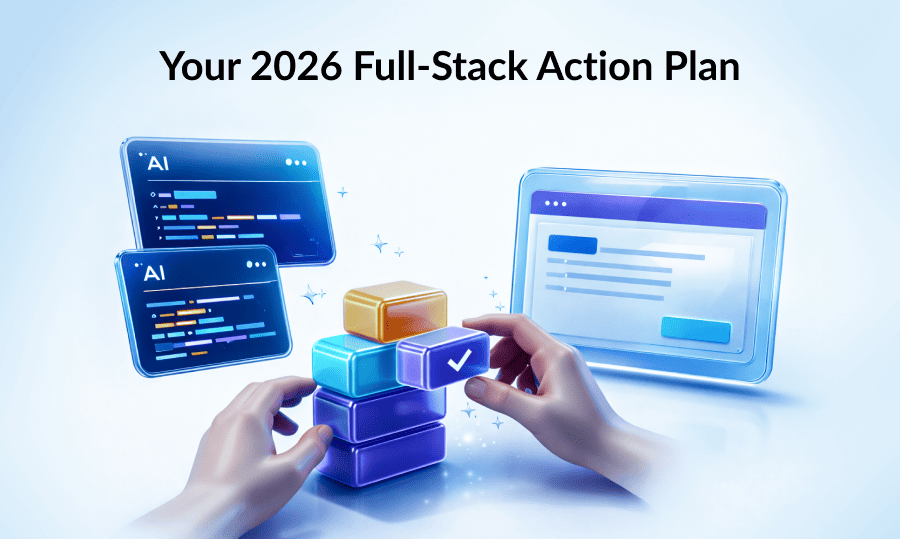
Your 2026 Full-Stack Action Plan
This shift demands deliberate action. Staying relevant is no longer about learning more tools, but about changing how you apply them in real-world systems.
Use Low-Code With Intent
Treat low-code platforms as accelerators. Learn where they save time and where custom code is essential. This balance defines real low-code developer skills.
Work With AI, Not Around It
Use AI to draft code, then refine, test, and secure it yourself. Demonstrating judgment is central to the long-term relevance of AI developers.
Study Systems, Not Stacks
Learn how data moves through an application and where failures occur. Frameworks will evolve, but understanding architecture and integration logic keeps your skills relevant.
Document Your Decisions
Explain why you chose a tool, an API, or a design approach. Employers value reasoning over output in the low-code AI era of 2026.
The Next Generation of Full-Stack
AI and low-code doesn't mean the end of full-stack development. They are just discontinuing a narrow version of it.
The next generation of full-stack developers will ship faster and think broader, combining speed with stronger judgment.
For junior developers, the choice is clear. Treat AI and low-code as shortcuts and risk shallow expertise, or use them as force multipliers while continuing to build solid fundamentals. The difference shows up in how problems are framed, trade-offs are evaluated, and systems hold up over time.
Those who invest in depth, judgment, and adaptability will not be replaced. They will define the new baseline for what full-stack work looks like.
Are you ready to build full-stack skills that last?
Explore SkillStone’s Full-Stack courses and stay relevant in an AI-driven world. Get started.
FAQs
1. Does low-code and AI mean fewer jobs for junior full-stack developers?
Low-code and AI are reducing the volume of routine entry-level work, but they are not eliminating opportunity. Instead, the junior full-stack future favors developers who understand systems, manage integrations, and evaluate AI-generated output.
2. What skills matter most for maintaining AI developer relevance in 2026?
AI developer relevance will depend less on writing code from scratch and more on decision-making. This includes reviewing AI output, understanding architectural trade-offs, and knowing when low-code tools should or should not be used. These skills allow developers to work faster without sacrificing quality or security.
3. Can low-code platforms support a future-proof full-stack career?
Yes, when used deliberately. Low-code developer skills are valuable when combined with strong fundamentals in APIs and system design. Developers who treat low-code as an accelerator can build a future-proof full-stack career.

 |
Dec 12, 2025 |
6 minutes read
|
Dec 12, 2025 |
6 minutes read